AI slide generation that writes in each teacher’s own voice.
TeacherAIde learns a teacher’s style from their own lecture materials, then generates decks that already sound like them - designed, built and shipped by a single engineer.
- UploadedLecture materials
- FingerprintedStyle metrics extracted
- GeneratedOutline, content, speaker notes
- ExportedDeck sent to Google Slides
Voice-matched decks
Style fingerprint, scored per deck
Billing built in
Stripe plans, webhook-verified
One engineer
Backend, frontend and AI workflows
A first draft that sounds like you.
Generic AI tools give teachers slides in the wrong structure, tone and depth. TeacherAIde measures how a teacher teaches, then generates decks that match.
Key capabilities
What the product doesStyle fingerprint
Learns how a teacher teaches.
- Weighted style metrics from uploads
- Scores new decks for consistency
Generate & export
From fingerprint to a deck ready to present.
- Outline, content, personalization, notes
- Google Slides export, PDF and preview
Plans & billing
A paid product from the first day.
- Stripe subscriptions and plan changes
- Server-verified webhooks drive account state
Admin dashboard
Platform health at a glance.
- Generation runs and their status
- Teacher accounts and billing health
Structured by design. Tuned on real data.
Next.js · NestJS · AWS Lambda · PostgreSQL · Claude · n8n · Stripe
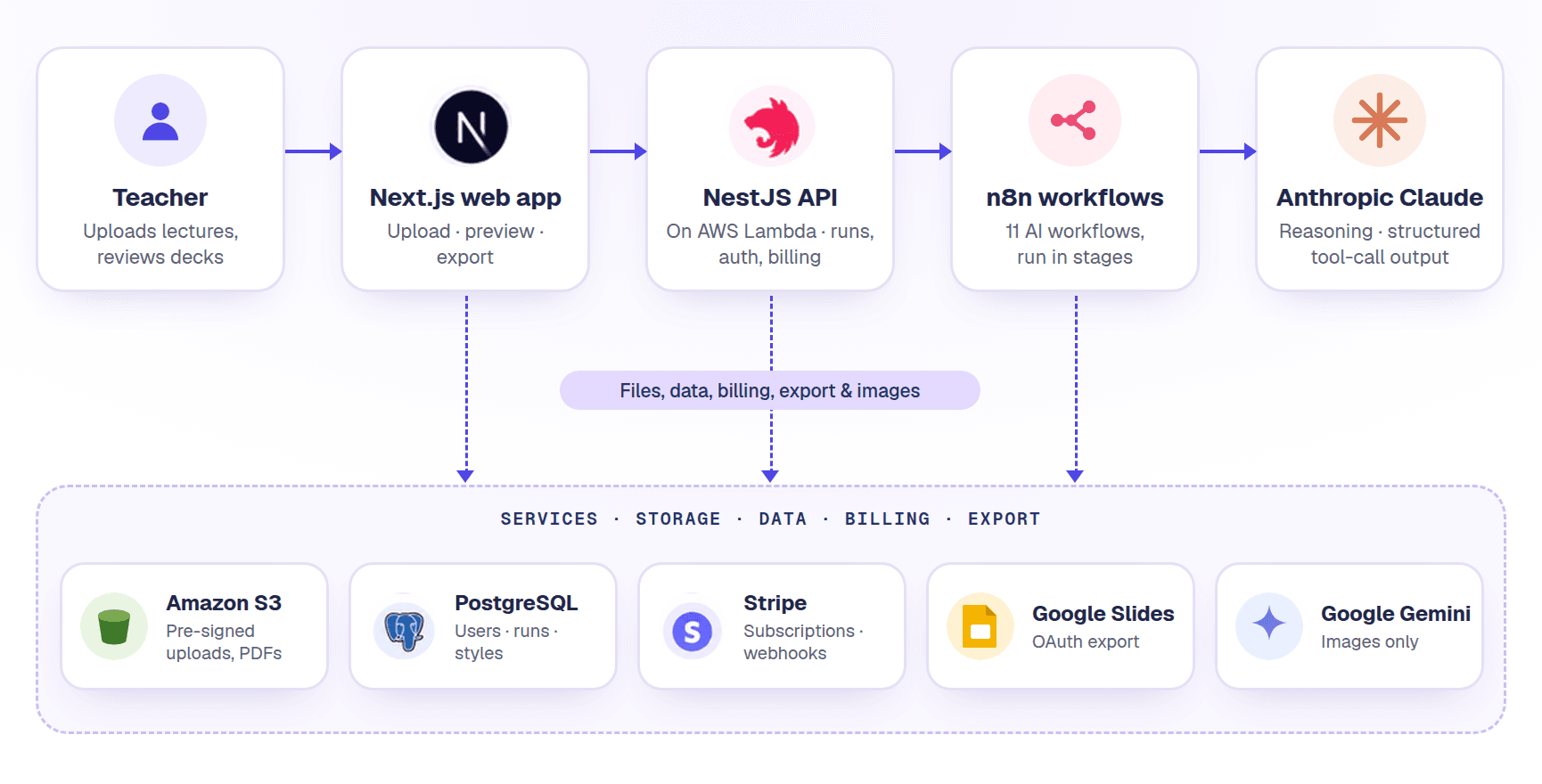
How it was built
Four steps to productionChallenges
Problem, then fixWhat it delivered.
Impact
Who it changed things forA draft that sounds like them
Decks arrive in the teacher’s own structure and tone, not a template to rewrite.
Billing you can trust
Stripe subscriptions and plan changes, with server-verified webhooks driving account state.
Changes ship like code
Prompts and pipelines are versioned and deployed by CI, with no manual n8n export step.
One engineer shipped a production AI product - schema and Stripe billing, Google Slides export, prompt design and CI/CD.
Muhammad Abdullah · AI Engineer, TuringStart a similar project